Medien zum Download.

Top Chocolate Equipment Manufacturers for Global Buyers

Chocolate production depends on a coordinated line, not one impressive machine. Roasting, winnowing, grinding, refining, conching, tempering, and molding each affect texture, flavor, yield, and delivery schedules. For global buyers, choosing Chocolate Equipment is therefore a practical investment decision, shaped by product range, target capacity, local service, and the cost of downtime.

Market conditions make careful evaluation more important. The International Cocoa Organization’s May 2024 Quarterly Bulletin estimated a 439,000-tonne cocoa deficit for the 2023/24 season. That supply pressure can make efficient processing, predictable yields, and reduced product loss especially valuable. It does not, by itself, prove that any particular machine will save money. Specs can still mislead. PMMI’s 2024 State of the Industry report discusses automation and operational pressures across packaging machinery; its findings offer useful context, though they are not chocolate-equipment benchmarks.

This guide compares manufacturers through the details buyers can verify: stated throughput, batch flexibility, temperature control, cleaning access, automation options, installation support, and spare-parts availability. A tempering line that runs smoothly in a demonstration may behave differently with a buyer’s recipe, operators, and production schedule. Ask vendors for test-run results using comparable ingredients, and confirm what their capacity figures include. These checks are not glamorous. They can reveal gaps between brochure claims and factory-floor performance. The manufacturers featured here serve different scales and needs, so the best choice depends on the buyer’s process—not on a single ranking.
Top Chocolate Equipment Manufacturers for Global Buyers

Chocolate Equipment Manufacturers and Their Role in Production

Chocolate equipment manufacturers shape how ingredients move from cocoa mass to finished products. Their machinery supports refining, conching, tempering, molding, enrobing, and cooling. Each stage affects texture, gloss, and production consistency. A tempering unit, for example, must manage chocolate temperature carefully to help create a clean snap and smooth surface. A cooling tunnel then needs steady airflow and suitable belt speed. Small changes matter.

A manufacturer’s role extends beyond supplying machines. Reliable technical guidance helps buyers match line capacity, product type, available floor space, and cleaning routines. Ask how stated output rates were measured, and whether they reflect your recipe and operating conditions. Check access for maintenance, spare-parts availability, and operator training before installation. A tidy specification sheet can still miss practical details, such as clearance needed to remove a pump. Even a carefully planned line may need adjustment after production begins; that is worth acknowledging, not hiding.

Tips: Request a process-flow review before purchase. Share sample recipes and target batch sizes. Confirm cleaning steps, changeover time, and service response expectations in writing. Keep a little room for trial runs.


Core Equipment Categories Across the Chocolate-Making Process

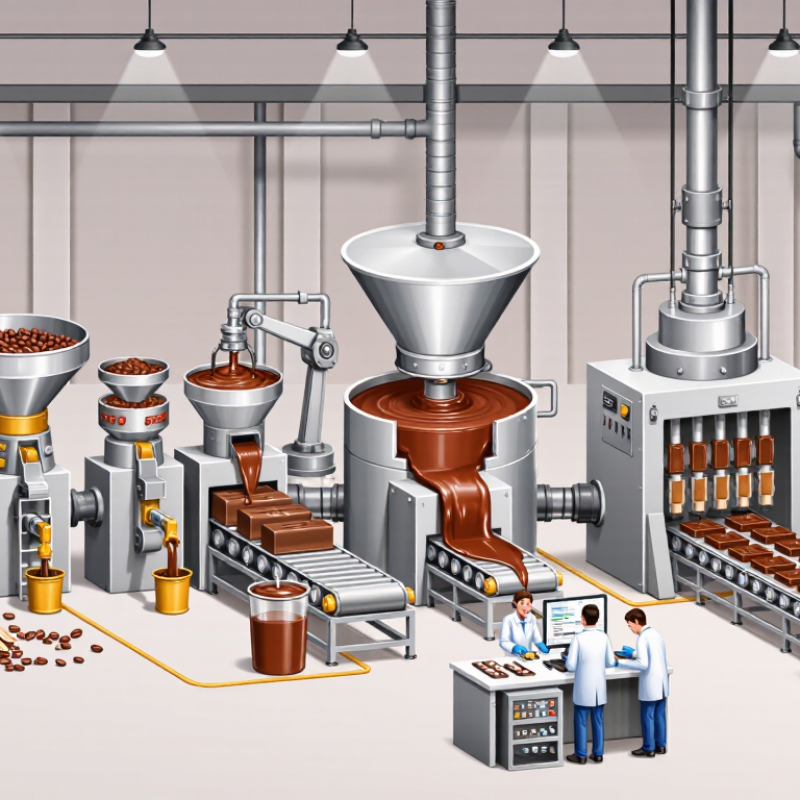
Chocolate production relies on connected equipment, not one isolated machine. Roasters develop aroma by controlling heat and time, while winnowers separate shells from nibs. Buyers should check batch capacity, temperature stability, and cleaning access. Small details matter. A narrow inspection door can slow routine maintenance.

Nibs move to grinding equipment, where they become cocoa liquor. Refiners reduce particle size, and conches mix and aerate the chocolate to shape its texture and flavor. These stages need careful coordination. A high-capacity refiner may overwhelm a smaller conche, creating delays between batches. Ask suppliers for process data using ingredients similar to your own; published capacity figures alone can be misleading.

Tempering machines manage crystal formation before chocolate enters molds or coating lines. Cooling tunnels then set products at controlled temperatures, while depositors, enrobers, and packaging machines support different product formats. Not every factory needs full automation. Labor, floor space, and local service access can change the right choice. Even good equipment needs adjustment, and product trials may expose gaps that a specification sheet misses. Buyers should compare cleaning procedures, spare-part availability, and operator training alongside output rates.

Top Chocolate Equipment Manufacturers for Global Buyers - Core Equipment Categories Across the Chocolate-Making Process
Process Stage Core Equipment Category Primary Function Key Selection Considerations Typical Process Connection
Raw-material preparation Bean cleaners and sorters Remove foreign material and separate cocoa beans by size or other measurable characteristics before processing. Cleaning efficiency, product handling, adjustment range, dust control, and ease of access for cleaning. Usually installed before roasting in cocoa-bean processing lines.
Bean processing Cocoa roasters Apply controlled heat to cocoa beans to develop flavor and reduce moisture. Batch or continuous operation, temperature control, residence-time control, heat source, and exhaust management. Typically followed by cooling and, where required, cracking and winnowing.
Husk separation Crackers and winnowers Break roasted beans and separate cocoa nibs from lighter shells using screening and airflow. Nib recovery, shell removal, feed-rate stability, dust collection, and suitability for the bean size range. Feeds cleaned cocoa nibs to grinding or liquor-making equipment.
Grinding Nib grinders and cocoa-liquor mills Grind cocoa nibs into cocoa liquor, also called cocoa mass; frictional heat releases cocoa butter from the nib particles. Required throughput, particle-size targets, temperature management, cleaning access, and downstream process needs. May supply liquor directly to mixing, pressing, or other cocoa-processing operations.
Ingredient mixing Chocolate mixers and batch mixers Combine ingredients such as cocoa liquor, sugar, cocoa butter, milk ingredients, and other recipe components. Batch size, ingredient-feeding method, mixing consistency, temperature control, and recipe changeover requirements. Prepares chocolate mass for refining and subsequent flavor development.
Particle-size reduction Chocolate refiners Reduce the size of sugar, cocoa, and other solid particles to produce a smoother chocolate mass. Target particle size, product formulation, throughput, energy use, and compatibility with the following conching step. Commonly positioned after mixing and before or as part of conching.
Flavor and texture development Conches Agitate and aerate chocolate mass to develop flavor and modify its texture and flow properties. Batch or continuous design, working capacity, temperature and airflow control, and recipe-specific operating needs. Receives refined chocolate mass and discharges chocolate for storage or further processing.
Flow preparation Chocolate holding and storage tanks Maintain chocolate mass in a controlled, workable condition between processing and forming operations. Usable capacity, temperature control, agitation, insulation, hygienic design, and transfer connections. Buffers production between conching, tempering, depositing, or enrobing.
Crystal control Tempering machines Control heating, cooling, and reheating of chocolate to encourage stable cocoa-butter crystal formation. Chocolate type, required flow rate, temperature-control accuracy, cleaning access, and integration with forming equipment. Supplies tempered chocolate to moulding, coating, or other forming equipment.
Product forming Depositors and moulding lines Meter chocolate into moulds to form bars, shells, and other moulded products; some lines also handle fillings or inclusions. Deposit accuracy, mould format, product dimensions, line speed, changeover time, and compatibility with the recipe. Typically followed by vibration or settling where specified, then cooling and demoulding.
Coating Enrobing machines Apply a controlled chocolate coating to centers such as biscuits, wafers, or confectionery pieces. Product dimensions, coating coverage, belt width, chocolate flow control, and integration with cooling equipment. Often connected to a cooling tunnel and downstream handling or packaging.
Setting and cooling Cooling tunnels Remove heat from moulded or coated products under controlled conditions so the chocolate can set. Product type, tunnel length, airflow and temperature control, belt configuration, and available floor space. Installed after moulding or enrobing; tunnel conditions are selected for the product and process.
Final handling Demoulding and product handling equipment Release set products from moulds and transfer them between production stages with controlled handling. Product fragility, mould design, transfer method, line layout, and ease of cleaning. Connects forming and cooling operations to inspection or packaging.
Packaging Chocolate wrapping and packing machines Wrap or package finished products and prepare them for storage and distribution. Product shape, packaging material, pack format, required line speed, coding needs, and downstream case packing. Usually located after product cooling, handling, and any required inspection.

Leading Manufacturers and Their Areas of Specialization

Chocolate equipment manufacturers often specialize in different stages of production, so buyers should match machinery to the product and factory layout. Some focus on refining and conching systems, where particle size, mixing time, and temperature influence texture. Others build tempering and depositing equipment for bars, filled pieces, or molded shapes. Small changes matter.

Enrobing specialists design equipment to coat centers evenly, while cooling tunnels help set coatings without dulling their finish. Packaging manufacturers concentrate on accurate wrapping, sealing, and line speed.

For each category, buyers can ask about changeover time, cleaning access, spare parts, and operator training. These practical details affect daily output as much as rated capacity.

A supplier’s specialization should fit the buyer’s actual recipe and production volume. A high-output line may be a poor choice for frequent small batches. During a factory visit, examine product samples, control panels, and accessible surfaces after cleaning. Ask how temperature stability is checked across a full shift. Brochures rarely show the awkward parts, and that gap deserves attention. Independent trials and clear service terms can help buyers compare claims fairly.

How Global Buyers Compare Suppliers and Technologies

Global buyers should compare chocolate equipment suppliers against the product they actually plan to make, not just headline capacity. A tempering line may run smoothly with one recipe but struggle when cocoa butter content or batch size changes. Ask suppliers to test a representative formulation and record throughput, temperature stability, and the finished chocolate’s texture. Small differences matter.

Look beyond the machine itself. Check whether controls show useful data, such as temperature trends and production rates, and whether operators can adjust settings without unnecessary complexity. Ask how long routine cleaning and changeovers take. A few extra minutes can affect a busy production schedule. Request details on installation, operator training, spare-part availability, and remote troubleshooting. Paper specifications rarely show the whole picture.

Compare technologies in a real production setting when possible. Observe how chocolate moves through refining, conching, tempering, and cooling, and note where manual checks remain necessary. On paper, every line looks efficient. Reality is less tidy. A supplier’s response to a difficult trial can reveal more than a polished presentation, though one test cannot predict every production issue. Record what was measured, what was assumed, and what still needs verification before comparing offers.

After-Sales Support, Compliance, and International Procurement

Top Chocolate Equipment Manufacturers for Global Buyers

After-Sales Support, Compliance, and International Procurement

Buying chocolate-processing equipment across borders involves more than comparing capacity and price. UNCTAD’s Review of Maritime Transport 2024 reports that shipping carries over 80% of world merchandise trade by volume. Delays can therefore affect installation schedules, spare-parts availability, and production plans. Before ordering, ask for a documented delivery scope, a named service contact, and realistic response times. Confirm which parts are stocked locally and which must travel internationally. Small details matter.

After-sales support should cover commissioning, operator training, maintenance schedules, and troubleshooting—not just warranty terms. Ask whether technicians can guide your team remotely, and request clear escalation steps for urgent faults. One common blind spot is failing to check whether support hours match the factory’s operating shifts. Even careful teams miss this. Codex Alimentarius’ General Principles of Food Hygiene emphasize appropriate maintenance and hygienic practices; buyers should check that equipment instructions support these routines.

Compliance needs to be verified for the destination market and the machine’s intended use. Review electrical specifications, guarding, documentation, and materials that contact food with qualified local advisers. Request manuals, declarations, and maintenance records before shipment, not after customs or installation issues arise. Also confirm who pays for translation, training, and replacement components. A polished quotation can still leave these responsibilities unclear.